The State of AI - June 2026
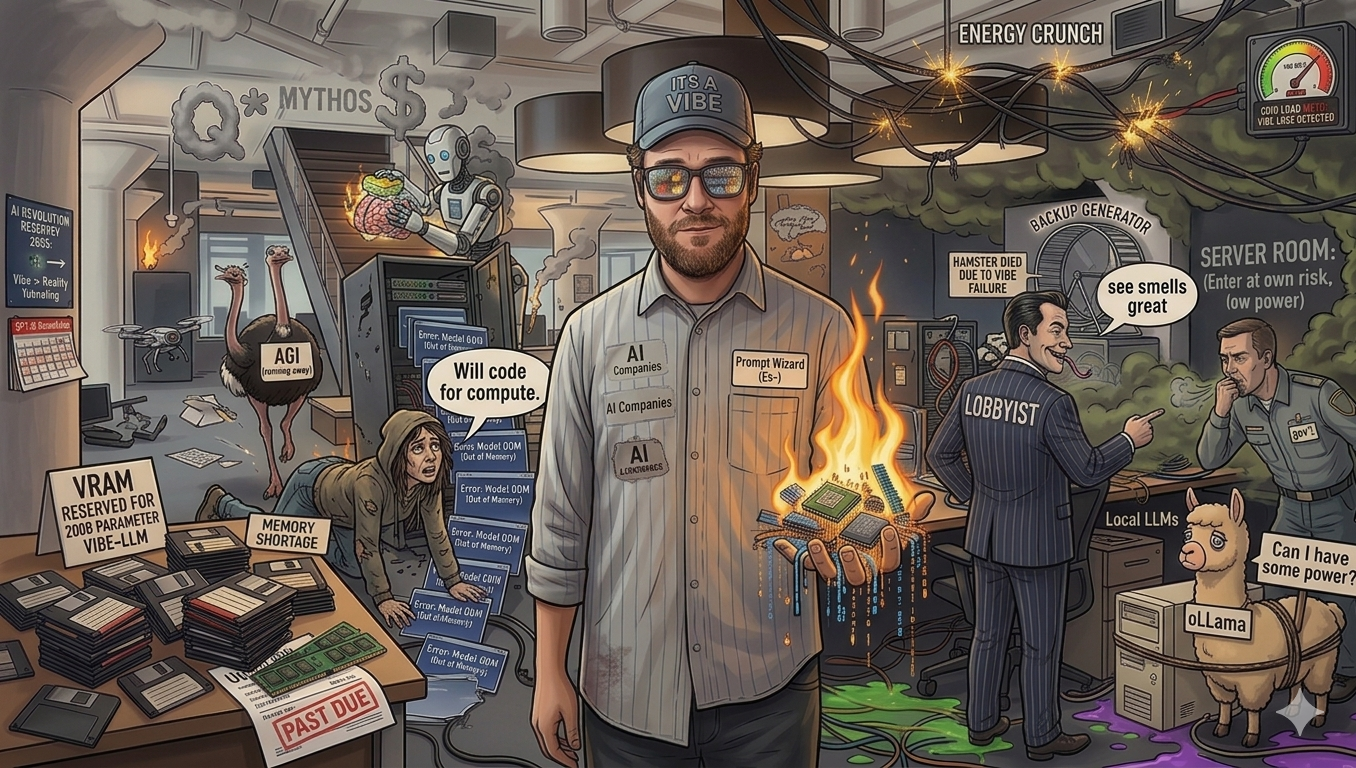
Like a lot of people these days, I am one of those "unemployed tech bros" you hear so much about. I am a human who has watched the outlook of a career (one where I spent years curating skills to excel at) evaporate right in front of my eyes. I have been bitter, resentful, fearful, and frankly, pissed about it. As anyone does as they progress through the stages of grief to mourn the death of their career, I eventually landed on acceptance.
This comes despite being highly skeptical of the current modus operandi, where frontier AI companies are spending billions to build giant data centers to handle compute, with the sole goals of profitability and efficiency. At what cost?
If we take the economics and the impact on our collective shared resources (like our electricity) out of the equation, you still have a Netflix-type SaaS model that is not sustainable, reliable, or controllable. Personally, I've never wanted anything to live on "someone else's computer." I want to own my digital property; just as I don't leave my real-world property at someone else's house, it just doesn't make sense (but that's a topic for a different day).
Sure, it's affordable now, but just a year ago it was free, and six months ago it was only $20. Now there are $100 and $200 tiers, quickly being replaced by per-usage metering. If these SaaS companies are to be believed, we are in a zero-sum game where early adopters extract all the wealth and laggards are entirely replaced. Should this service be more akin to a utility like electricity or water, not one only available to the privileged who can afford to pay the toll?
Remember when streaming seemed like a fantastic value proposition? $5.99 a month for all your favorite TV shows. Now you have ten services that cumulatively cost more than cable.
The Cost of Capitalism
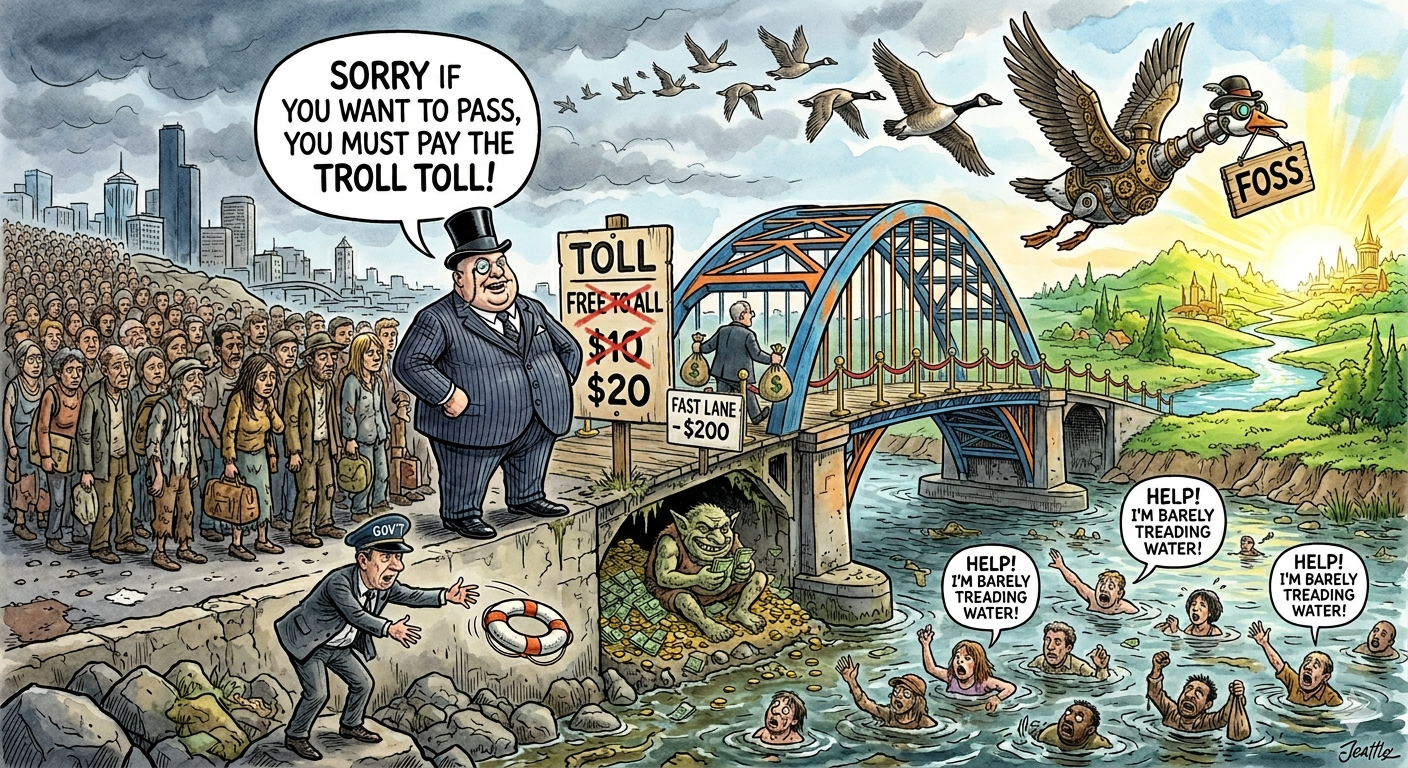
Unfortunately, I know all too well the consequences of this game we call capitalism, both good and bad. Thanks to remote work, the COVID hiring boom extended me a lifeline, enabling me to pursue my dreams of moving across the country to find my flock. (I apologize in advance for the bird puns)
In the same breath, that capitalist engine has been directly responsible for, or a major catalyst for, "not an insignificant amount" of my distress in this life. Over the past four years, I have been laid off three times, each as part of one of these "shifts in tech" that the news love to sensationalize. All of them were due to cost-cutting in the pursuit of infinite growth, which is quite a boondoggle if you ask me, not that anyone has.
These layoffs may have saved the tech companies a few dollars and served some short-term quarterly goal, but they have a lifelong impact on the people who make these companies tick. The ones who toil for hours building someone else's dream, who add value, who sacrifice, so that executives and shareholders can reap the rewards.
So, as I sat applying for job after job, trying to keep myself motivated while exhausting all the social safety nets we all naively think are enough until we actually need them, I found myself becoming increasingly desperate. Unable to find even part-time work that would pay enough to sustain my existence, I thought to myself: Why did you get into this career? It was to have a stable, in-demand skill set that could enable me to be self-sufficient and provide for my family. Oh yeah, and to build really cool shit. So, like Bear Grylls says: we improvise, adapt, and overcome.
From Doom Spiral to Demo Day
My first foray into AI and agentic coding was January of 2025. I tried the beta of Goose 1.0, Ollama, Gemini, ChatGPT and "vibe coding" in various IDEs. As with a lot of things, I was just too early to fully realize the vision. Came in filled with wondrous possibility but was snapped back to the sparse, bug-laden foundation that comes with being on the bleeding edge.
I then spent the better part of a year in a doom spiral, waiting for the collapse of the modern age. I wasn't prepared for the breakneck speed at which this technology is advancing. This has been the equivalent of speedrunning decades of smartphone advancement, from the flip phone to the modern iPhone, in mere months.
Fast forward to around January of 2026, Claude Code started popping up everywhere, claiming it could really become a "code monkey" and build stuff. I figured $20 is like a burger and fries these days, so what the heck. Well... let's just say I was floored by the capabilities.
I took an end-to-end idea: a family game that has never been written down or played outside of maybe a dozen people. This project had a hard requirement: no external infrastructure. I can't afford rent much less a monthly server bill, and I definitely don't want the responsibility of securing customers' private data or fighting AI bots. I want to build software as a product like it was before the Dotcom bubble: you pay one fee, you get the complete game, no in-app purchases, no added value extraction.
Using a 5x5 Dev Cycle powered agentic development, a single HUMAN can condense a carefully planned sprint from five days down to five hours. Imagine what a full team could accomplish, condensing an entire month into one week, giving EVERYONE that mythical "work-life balance" we all deserve.
This got my app from idea to beta testing in three months, most of which was limited by the five-hour Claude Code buckets. I would blow through my usage within an hour doing major refactors or architecture changes through PRDs and tech specs, then spend the next three hours testing, then an hour prepping for my next sprint. It was both enraging to have to stop-and-go, and exhilarating, as it gave me just the right amount of urgency.
The Experiment
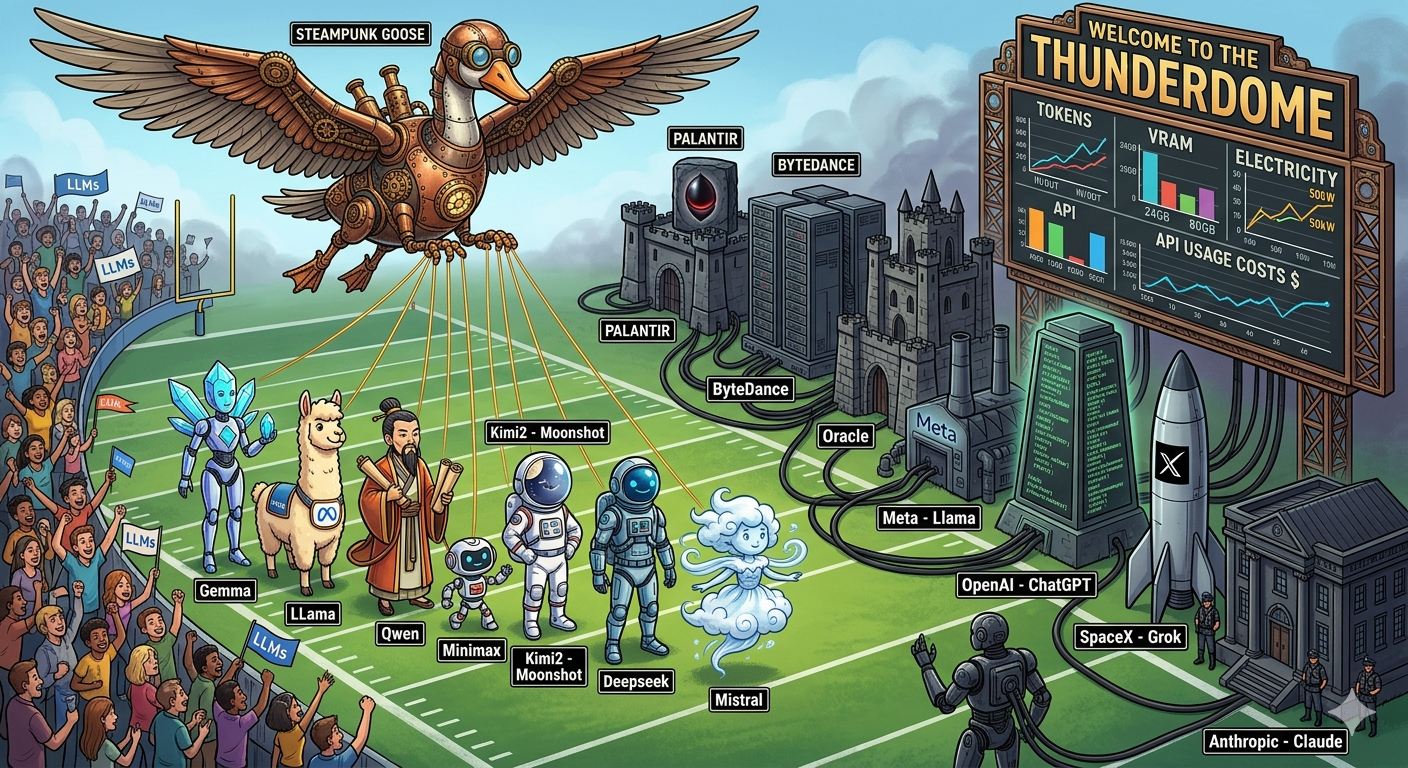
Over the past few months, I conducted a scientific experiment that yielded greater than expected results. Not only have I built the game with a custom game engine, multiplayer, and AI bots trained on the game, but it's all built on the back of Apple's privacy-focused infrastructure. For better or for worse, I can't even tell what my users' emails are.
I also built a device-to-device multiplayer system that uses AWDL and Bluetooth to manage a serverless turn-based game, creating a direct mesh network between up to four players. This not only solves a key constraint for playing on a morning train commute or in spotty service, it allows people to play over a campfire in the middle of the woods where cell service is impossible — which was basically my childhood in rural New York.
As my codebase grew in complexity, my $20 Claude Code subscription became the main bottleneck. Despite the constant marketing and attempts to upgrade, I refused based on principle. This was giving me PTSD akin to how the streaming industry started as an amazing value proposition and quickly diverged into a frustrating, fragmented value extractor. Are you seeing the pattern here?
I can't help but think we are in a golden age of accessibility with this stuff. Think the internet before advertisements, propaganda, and data harvesting poisoned it all. That it soon won't be accessible to most people. We were the beta testers for getting this AI working so that it could replace ten people with one person and a tool. This has happened many times in human history. It's how technology advances.
Now we are circuitously getting to the point of this whole rant, and that is not to instill doom and gloom, but HOPE.
I am a big proponent of FOSS (Free and Open-Source Software). Imagine how different the world would be without people like Linus Torvalds giving us Linux and Git for free, not hiding them behind some pay-to-play service.
About a month ago, I started hearing about a new open-source model from Alibaba called Qwen, and how it was allegedly performing nearly as well as the frontier models, the ones that require an astronomical amount of compute power. Taking politics or nationalism out of it, the builders in China were forced to design under immense resource constraints, meant to cripple their capabilities. Instead, necessity appears to be the mother of invention again, and it enabled them to build models for a fraction of the cost that run on devices like your MacBook or gaming computer. Devices that we already have in our homes and offices, devices that don't sap our resources or poison our environment.
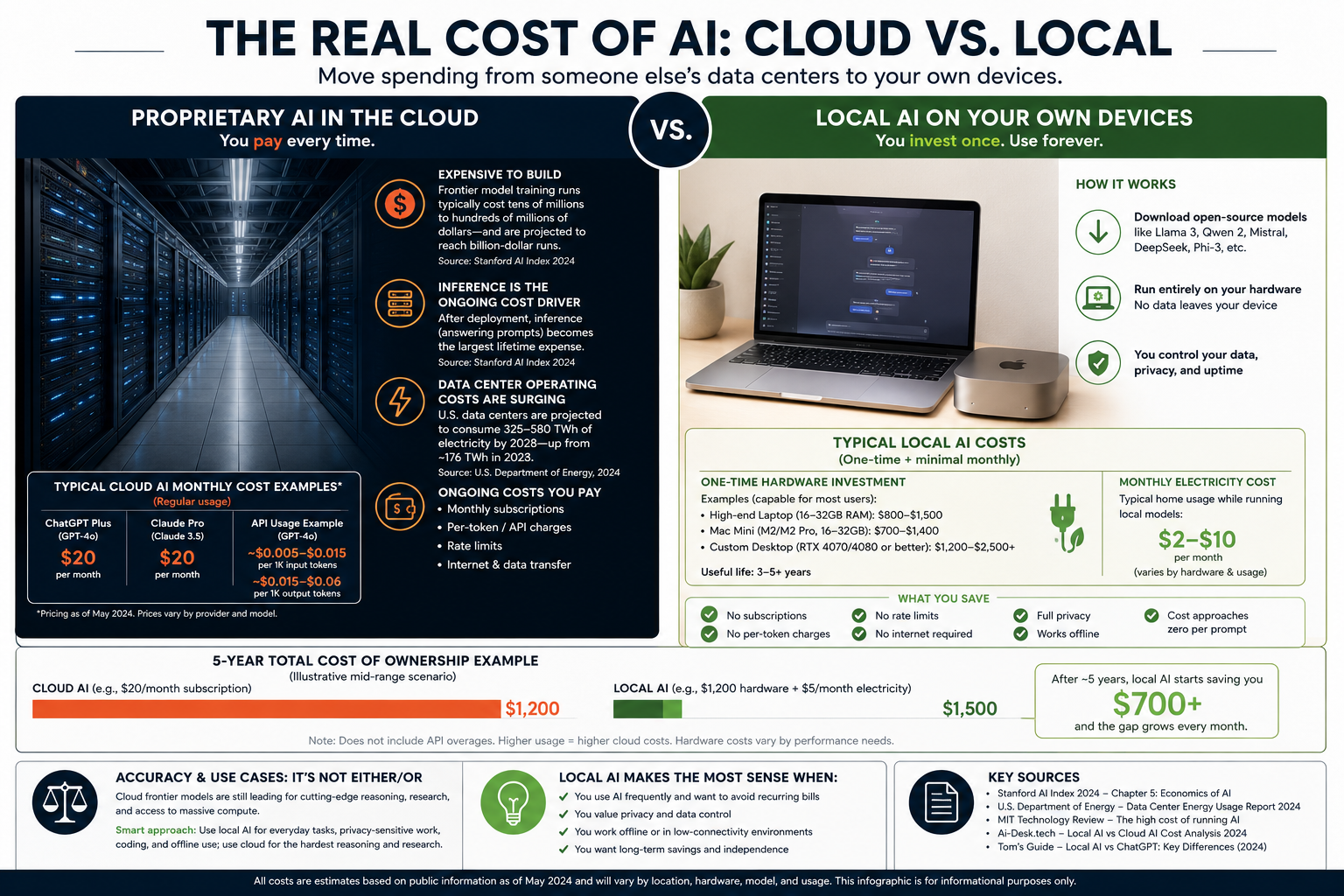
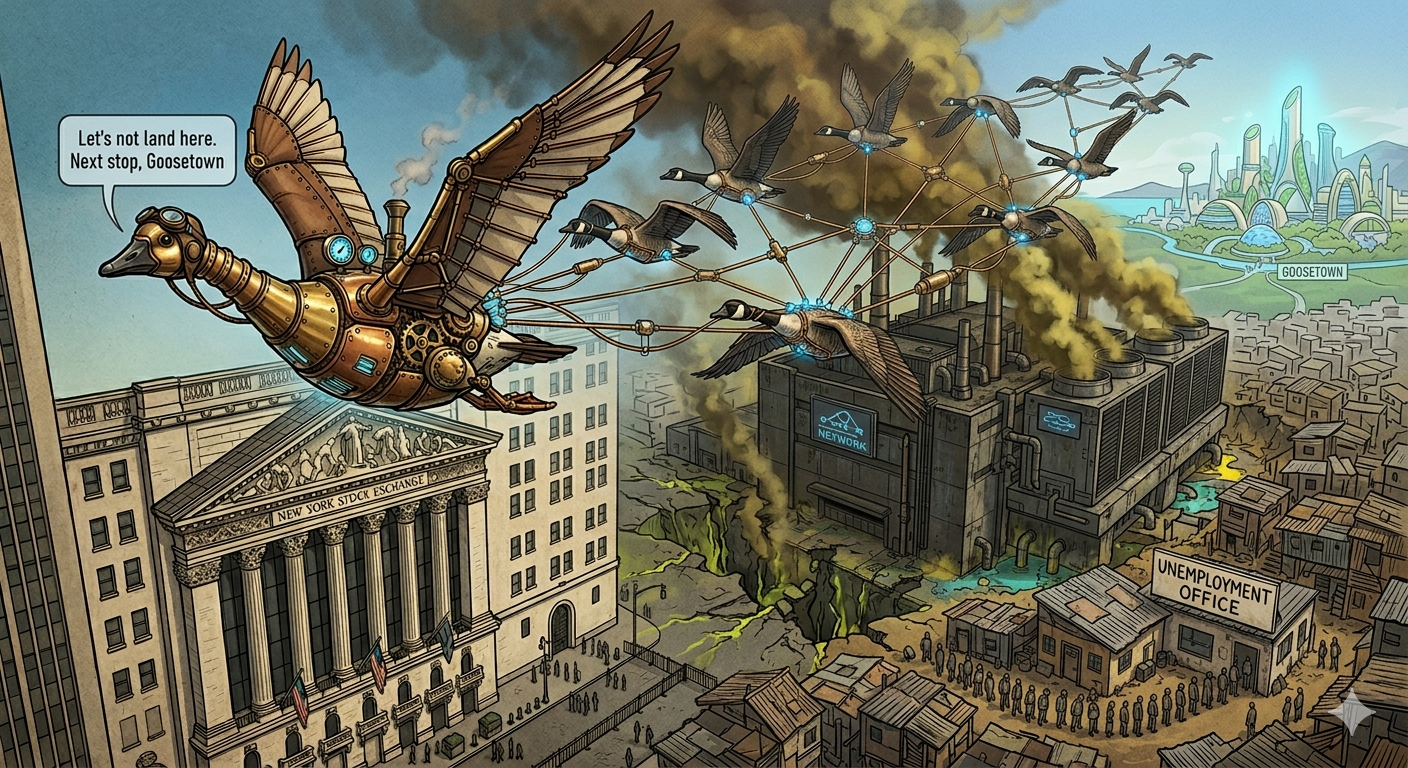
With proper setup and tuning, this technology has the ability to impact more actual human lives than any other piece of technology since the advent of the internet. It could enable people with initiative, drive, and perseverance to circumvent and overcome obstacles that in previous generations would have "taken a village."
I think these FOSS tools are going to be what remains after the coming bubble pops, just like various websites went under during the Dotcom bubble while open-source tools and web pages as a concept endured.
Earlier in this dissertation, I mentioned Goose. Check it out! It is another piece to this puzzle that arguably has been flying way under the radar (see what I did there :D). Goose is an agentic tool, created by Jack Dorsey's Block and donated to the newly formed Agentic AI Foundation (part of The Linux Foundation) at the end of 2025.
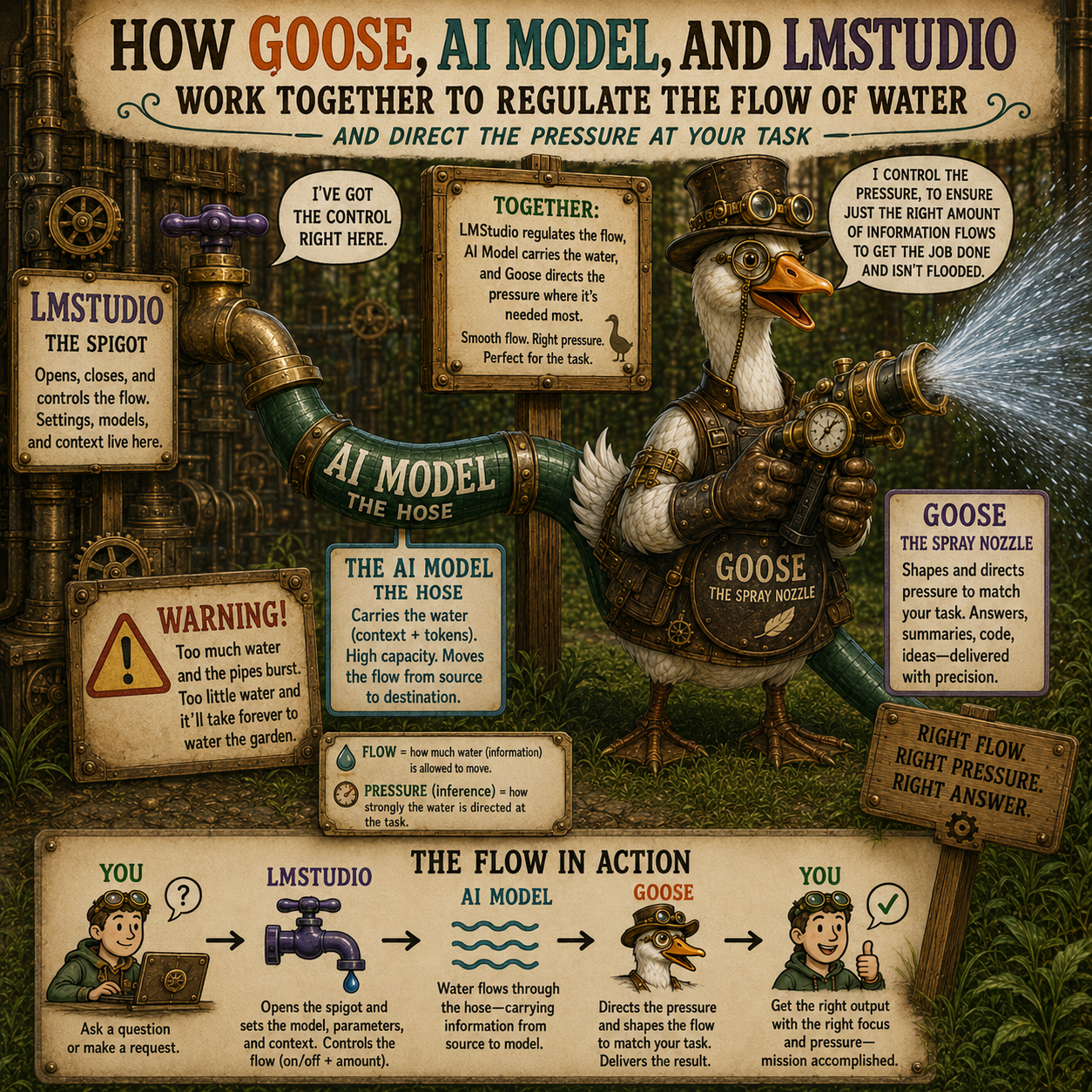
Now you may be wondering how the heck all of this works, so I had my robots draw up an analogy:
The Local Stack
My current setup uses LMstudio to house my LLM inside a sandbox with no access to the internet or any files outside of its directory, and Goose with custom integrations via MCP (Model Context Protocol) to Xcode (Apple's IDE for making iPhone apps) all running on my M1 Max MacBook with 64GB of RAM from 2021. The model is Alibaba's Qwen3.6 27B in a 6-bit MLX build designed to run on Apple Silicon.
Goose has granular permissions configured, requiring my express approval to make code changes, alter files or try to build its own tools. I also use version control via Git, so the worst that can happen is I undo everything and roll back to the previous build.
- Context window32 768 tokens
- Prompt templateJinja
- System promptblank (Goose owns it)
- Server port1337
- Context overflowrollingWindow
- LM Studio ver.0.4.16+
localhost:1337 ↓Consumes plan files. Produces numbered steps with acceptance criteria.
Implements Swift 6+ / SwiftUI / GameKit plan steps. No presence penalty.
SwiftUI views, layout, animation. Higher temp for creative variation.
Root cause across turns. Preserve thinking on, retains reasoning chain.
Low temp for deterministic critique. Audits Swift for correctness, Swift 6 concurrency warnings, and App Clip size budget.
Think on + preserve on. Designs systems: Core Bluetooth transport, App Clip boundaries, Game Center matchmaking flow. Use before Planner.
Carries the reasoning chain forward turn to turn. Costs more tokens but avoids re-deriving context. Right for multi-turn work on the same problem.
Each turn starts completely fresh. Prior reasoning is discarded. Right for single-shot tasks where prior context is irrelevant or would mislead.
Extension: xcode-index-mcp (from Block) provides Goose with Xcode symbol index access. Project root has a .gooseHints file with project-specific context.
Sandbox mode is enabled and express approval is required for web access or writes outside the project directory.
The Mythical Man-Month
My codebase is not spaghetti code or "AI slop". I utilized the AI the same way I utilized my team as a product manager, basically replicating my entire team's workflow within this tool. I utilized multiple "agents" by customizing each model's presets, tweaked to be most effective for that specific use case.
Here is a good example of a code snippet from a bug that I just fixed thanks to some beta testers. I used the Debugger config to determine the bug, providing it with screenshots, game logs, and the relevant areas in the code. I asked it for a root-cause analysis, which was then passed to the Coder to go make the changes, with robust timestamped comments that make it easy to follow, maintain, and most importantly, learn from.
// MARK: - Discard Pickup Validation
// -----------------------------------------------------------------------
// A player can only pick up from the discard pile if the picked-up cards
// help form a valid run in combination with their current hand.
//
// The rule: at least ONE of the picked-up cards must participate in a
// scoreable run. You can't pick up just to collect more cards without a play.
//
// Implementation: combinatorial search, check every possible subset of the
// combined (hand + pickupCards) that includes at least one picked-up card.
// This is O(2^n) in the worst case but hands are small (max ~25 cards).
// -----------------------------------------------------------------------

/// Returns true if the player can legally pick up `pickupCards` from the
/// discard pile.
///
/// Pickup is allowed when EITHER:
///   A) The combined cards (hand + pickup) can form a brand-new valid run, OR
///   B) At least one picked-up card can extend an existing scored run.
///
/// - Parameters:
///   - pickupCards: The cards being picked up from the discard pile.
///   - hand: The player's current hand.
///   - scoreZones: All scored runs currently on the table (across all players).
///                 Pass `[]` to check Condition A only.
// [2026-06-07] Added scoreZones parameter to allow extension-based pickups.
// Previously only checked brand-new run formation, rejecting legal pickups
// where the discard card extended an existing run (e.g., picking up A to
// extend J-Q-[wild→K] on the table).
static func canPickUp(cards pickupCards: [Card], withHand hand: [Card], scoreZones: [[Card]] = []) -> Bool {

    // Condition A: can form a brand-new valid run from combined cards.
    let available = hand + pickupCards
    if available.count >= 3,
       pickupCards.contains(where: { card in
           hasScoringComboContaining(card, in: available) }) {
        return true
    }

    // Condition B: at least one picked-up card can extend an existing run.
    // Reuses canExtend() which handles wildcard-aware runs, ace-high/ace-low,
    // locked wildcards, etc.
    for pickedUpCard in pickupCards {
        for existingRun in scoreZones {
            if canExtend(existingSet: existingRun, with: [pickedUpCard]) != .invalid {
                return true
            }
        }
    }

    return false
}Why This Matters to You
Now, why does all of this matter to you?
You may be an individual contributor sweating as you wait for the inevitable layoff. You may be a middle manager caught between two conflicting forces: looking out for your team or ensuring your company survives the coming crunch. You may be a board member or executive whose AI budget for 2026 is already depleted. You may be a founder with a great idea looking for a tool to bridge the gap to that first prototype.
Regardless, I would like to help you, the hooman, figure out how to best take advantage of this wonderful tool. A technology that is based upon the collective work of all our human intelligence.
Contact me if you'd like me to consult for an hour, a week, or a month. I will embed myself into your workflow like a tick and make you feel like you have a fighting chance at surviving this coming storm.
With access to dozens of highly skilled A-players who are all looking for work, the most cutting-edge tools technology can provide, and a shared passion for the human experience. Maybe, just maybe, I can use this opportunity to establish the next great tech consulting company. One that truly adds value to the world, honors its employees, shares not just the profits but the ownership, and upholds that social contract I thought we all collectively signed.
The idea that if YOU'RE willing to work; it doesn't matter who YOU are, or where YOU come from, or what YOU look like, or who YOU love. It doesn’t whether YOU'RE black, or white, or hispanic, or asian or native American, young or old, rich or poor, able, disabled, gay or straight, YOU can MAKE IT here in America.
But hey that’s just the entitled millennial in me, so let’s take it one step at a time.
The Beacons are lit!
Be warned though, I am not sycophantic like AI, and I am definitely not a "yes-man". I will challenge your perspective when warranted, whether you're a college student or an executive. People who know me know my skill set comes with a certain intensity and passion; I challenge the status quo.
There will be times when that intensity rages like the beacons of Minas Tirith. It may feel like the gaze of Sauron is upon you, but it will always be directed at the thing and never the human behind the thing. Like Sauron and Frodo, we can fixate on your "precious" together, attacking your idea from both sides with a single goal: to make it there and back again.
Thank you for reading; never stop caring.